_edited.png)
Phytopharmaceutical Drug Approval in India: From Cannabis Research to an Approved Medicine

By Delta Botanicals & Research · Last reviewed: 5 October 2026
This article is a development overview for business and research planning. It is not legal, regulatory or medical advice. Requirements for a specific candidate depend on the product, the activities involved and current regulatory decisions.
Key takeaways
A cannabis phytopharmaceutical must be a purified and standardised fraction with at least four defined compounds. A crude extract, a "full-spectrum" oil and a single isolate each fall short of that definition on their own.
Cannabis is an expressly named research focus in India's 2018 CSIR–DBT–ICMR programme. That shows research selection, not marketing approval.
Approval runs through CDSCO under the New Drugs and Clinical Trials Rules, 2019. Commercial supply also needs manufacturing or import licences and continuing safety oversight.
Cannabis adds material-specific controls at every step. The 2026 "prior intimation" route for test licences excludes narcotic and psychotropic substances.
Changing the source or formulation mid-programme can mean extra comparability work. Price a cheaper source against that work.
Settle six questions before committing major capital (below).

Before committing capital to a cannabis drug-development project in India, a sponsor needs to define the medicine it intends to bring to market. Which condition will it address? What will the patient receive? Can the same product be manufactured consistently as the programme moves from research to clinical trials and commercial supply? Those decisions shape the approval pathway, the partners required and the evidence the business must fund.
India has a regulatory framework for phytopharmaceutical drugs. Cannabis also has an explicit place in the country's publicly backed development agenda: the 2018 CSIR–DBT–ICMR agreement named two cannabis-based therapeutic leads.[3] Together, the framework and the agreement give companies a concrete starting point.
How does phytopharmaceutical drug approval work in India? A developer establishes a qualifying, standardised plant-derived product, secures the applicable material and research permissions, generates quality, nonclinical and clinical evidence, and applies to CDSCO for the relevant new-drug permission. Commercial supply requires the applicable manufacturing or import licences and continuing safety oversight.
Cannabis adds material-specific legal controls to this process.
This guide focuses on medicines for human use and on the decisions facing pharmaceutical companies, research sponsors and cannabis businesses considering the Indian pathway.
In this guide: what qualifies · the MoU evidence · the eight development steps · a hypothetical example · six questions before committing capital · cost and timing · FAQs
What Qualifies as a Phytopharmaceutical Drug?
A phytopharmaceutical is a purified and standardised fraction of a medicinal plant extract, with at least four defined bioactive or phytochemical compounds assessed qualitatively and quantitatively.
Parenteral administration, such as injection, is excluded from the definition.[2] The Indian Pharmacopoeia Commission development guidance adds that at least one of the characterised compounds should be bioactive, while the others may serve as analytical markers.[1]
For cannabis, classification depends on what is actually being developed:
Proposed product | Implication for classification |
Crude cannabis extract | Does not, by itself, satisfy the purified and standardised fraction requirement. |
"Full-spectrum" cannabis oil | The marketing description does not establish composition, characterisation or regulatory status. |
Pure CBD isolate | A single isolated compound does not meet the four-compound fraction definition. A different drug pathway may be relevant. |
Purified, standardised cannabis fraction | A potential fit, subject to its composition, characterisation, intended use and supporting evidence. |
Ayurvedic cannabis formulation | Must be assessed under its applicable ASU framework. An AYUSH authorisation does not substitute for phytopharmaceutical approval. |

The four-compound requirement is only part of the assessment. The developer also has to demonstrate quality, safety and efficacy for the proposed product. Adding arbitrary markers to an isolate would not make a scientifically justified phytopharmaceutical candidate.[1]
If your project may sit on the Ayurvedic side of this line, see our guides to Cannabis in Ayurveda and developing an Ayurvedic cannabis product.
For project planning, classify the candidate before committing to a manufacturing specification or clinical programme.
Cannabis and India's Phytopharmaceutical Mission: The Documentary Evidence
The tripartite MoU signed on 31 December 2018 by the Council of Scientific & Industrial Research (CSIR), the Department of Biotechnology (DBT) and the Indian Council of Medical Research (ICMR) selected seven named initial development leads. Two were cannabis-based.[3]
Cannabis lead in the agreement | Intended therapeutic application |
Cannabis-based phytopharmaceutical with THC:CBD in a 1:1 ratio | Pain management |
Cannabis-based phytopharmaceutical with CBD | Paediatric epilepsy |
These entries appear on printed page 3 of the MoU, the fourth page of the PDF. They establish cannabis as an expressly selected research focus within the inter-ministerial programme. They do not establish approved indications, and they do not show that the CBD candidate was a pure isolate.[3]
A national research effort with distinct programmes
The official names matter. The CSIR Phytopharmaceutical Mission, DBT's Phytopharmaceutical Mission for the North East Region and the CSIR–DBT–ICMR inter-ministerial cooperation programme have related but distinct scopes. The tripartite programme is the specific source for the cannabis leads above.[5]
CSIR's broader mission connects medicinal-plant cultivation, processing and drug development, and its current project list includes Phytopharmaceuticals Mission Phase III, 2024–27.[5] Cannabis is therefore best described as a documented therapeutic development focus within India's national phytopharmaceutical effort, not as the focus of the entire Mission.
What makes the MoU commercially relevant
The agreement allocates the work needed to advance a research lead:

Institution | Responsibilities described in the MoU |
CSIR, through CSIR-IIIM and participating laboratories | Botanical authentication, fraction characterisation, formulation, preclinical work, and chemistry, manufacturing and controls evidence supporting development. |
DBT | Proposing leads, providing research funding and contributing relevant dossier sections with ICMR. The annexure assigns projected funding for safety pharmacology and regulatory safety studies to DBT. |
ICMR and its institutes or hospitals | Preparing and submitting the final investigational dossier, developing trial documentation, obtaining clearances, and conducting and compiling clinical studies. |
The MoU envisages industrial participation and separate agreements for individual projects. For a prospective industry partner, that makes ownership of data, access to technology and responsibility for development important negotiation points. The umbrella agreement does not itself grant a private company access to a lead or its intellectual property.[3]
A later parliamentary answer shows follow-through. On 28 March 2023, the Department of Pharmaceuticals reported that cannabis for pain management and Boswellia for rheumatoid arthritis were undergoing IND-enabling studies under the tripartite arrangement, meaning studies intended to support an investigational new-drug submission.[6]
The evidence supports a precise conclusion: cannabis was selected for coordinated public-sector therapeutic development, with a defined route from botanical research towards clinical evaluation.
The 2023 update is a historical milestone, not proof of a current marketing approval. The original MoU also specifies a five-year term with renewal by consent, and that document alone does not establish whether it was renewed.[3]
The Phytopharmaceutical Approval Process in India
CDSCO, headed by the Drugs Controller General of India, administers the central new-drug pathway. The New Drugs and Clinical Trials Rules, 2019, as amended, provide the framework, and Table 4 of the Second Schedule addresses phytopharmaceutical submissions.[4] State licensing authorities, ethics committees and competent authorities for controlled material have separate roles.
The steps below describe a development sequence. Some activities can run together, but later decisions depend on the evidence and permissions already in place.
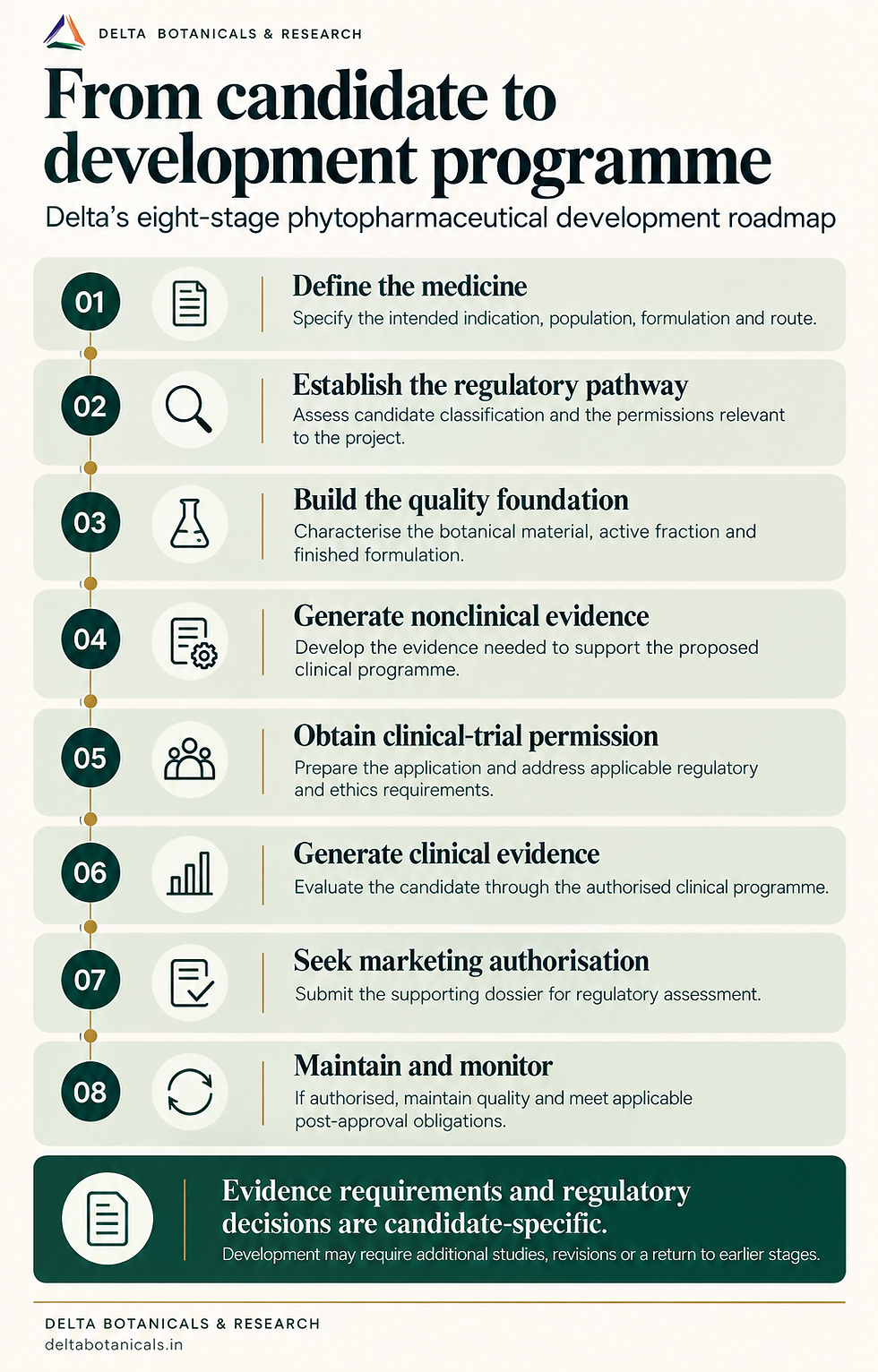
1. Define the medicine and the claim
Prepare a target product profile that identifies the botanical source, plant part, proposed fraction, dosage form, route, patient population and therapeutic indication.
For a cannabis project, "pain management" is a research direction. A trial programme needs a more specific clinical question, including the condition, the intended patients and the outcomes to be measured.
The IPC guidance separates published knowledge from data generated by the applicant. Use that distinction to assess what is established for the plant, what is known about comparable preparations and what still needs to be shown for your proposed product.[1]
Decision before spending: is the proposed claim specific enough to guide development, and is the evidence relevant to this candidate?
2. Confirm lawful material access and the supply chain
Map the actual material and every proposed activity, including procurement, possession, processing, storage, transport and any import or export. Medical or scientific purpose operates within the applicable NDPS requirements and authorisations. It is not a standalone permission, and central and state responsibilities both need to be considered.[7]
A sponsor should verify the scope of its own and its partners' permissions, including proposed transfers between sites. Build the botanical quality record alongside this assessment: taxonomic authentication, source, cultivar where applicable, collection and handling information, and raw-material specifications.
These are explicit areas of the IPC guidance.[1] Our sourcing guide sets out a five-part supplier check.
Decision before spending: can the intended research, manufacturing and testing sites lawfully obtain the required material with adequate traceability?
3. Establish the fraction and finished-product specifications
The chemistry, manufacturing and controls package (CMC) must connect the starting material to the ingredient and the finished medicine.
Product level | Evidence to establish |
Botanical raw material | Identity, provenance, handling, chemical profile and contaminant controls. |
Phytopharmaceutical ingredient (pAPI) | Preparation process, characterisation, marker assays, broader fingerprint, biological activity and stability. |
Finished dosage form | Composition per dose, manufacturing controls, product specifications, packaging and shelf-life evidence. |

The IPC guidance emphasises consistency beyond the four selected compounds. It combines botanical controls, analytical and manufacturing controls, biological assays and clinical evidence, and its illustrative marker ranges are not universal acceptance limits for every product.[1]
For cannabis, the practical implication is that a THC:CBD ratio alone cannot show that two fractions are equivalent. The wider composition and the finished formulation also matter.
Decision before spending: can the manufacturing and analytical partners define and reproduce the candidate that will be tested?
4. Secure the applicable development-batch permissions
The 2025 IPC guidance describes CDSCO permissions such as CT-11, CT-14 or CT-15, as applicable, alongside the state Form 29 framework. Clinical-trial batches must comply with the applicable Good Manufacturing Practices (GMP).[1]
The 2026 update is particularly relevant to cannabis. CDSCO circular of 6 March 2026, implementing G.S.R. 46(E) of 20 January 2026, introduced prior intimation through the National Single Window System for eligible analytical and nonclinical testing applications in Forms CT-10, CT-12 and CT-13. It expressly excludes narcotic and psychotropic substances, among other categories, and other cases remain under prior approval.[9]
Assess the actual material before assuming the simplified route applies. It does not provide clinical-trial permission or displace controlled-substance authorisations. Confirm state test-licence requirements against the current Drugs Rules, which have been amended recently.
Decision before spending: which permissions must each manufacturer hold before producing or supplying the proposed batches?
5. Generate nonclinical evidence and prepare the dossier
Design nonclinical studies around the intended use and exposure. The IPC guidance covers pharmacology, pharmacokinetics, toxicity, genotoxicity and other relevant safety assessments, with regulatory toxicity studies conducted under Good Laboratory Practice (GLP) requirements.[1]
Traditional-use literature can inform the programme. It does not automatically establish the safety of a differently processed fraction at the proposed dose. The analytical strategy also needs to support the biological work. Where pharmacokinetic study of a bioactive compound is not feasible, a justification must be submitted for regulatory consideration.[1]
A presubmission discussion with CDSCO can help address candidate-specific questions before formal submission, as the IPC guidance recommends.[1]
Decision before spending: will the proposed studies answer the regulator's questions about this product and its intended clinical investigation?
6. Obtain clinical permissions and evaluate the medicine in people
The standard clinical-trial application is CT-04, with permission in CT-06. The study also needs appropriate ethics approval, informed consent, safety reporting and arrangements for medical management and compensation under the applicable rules.[2][4]
Register the study with the Clinical Trials Registry of India (CTRI) before the first participant is enrolled. A submission reference number is not a completed registration.[10]
Clinical development generally addresses early safety and tolerability, dose exploration and confirmatory evaluation, commonly through Phase I, II and III studies. The programme, and any justified abbreviation or relaxation, requires regulatory consideration.[1] For a cannabis candidate, the clinical team must resolve dose selection, concomitant medicines, appropriate endpoints and blinding, and the sponsor must maintain product quality across the studies.
Decision before spending: is the clinical programme designed to substantiate the proposed claim using a product the business can continue to manufacture?
7. Apply for marketing permission and complete commercial licensing
The final submission brings together the product's quality, safety and efficacy evidence, proposed labelling and relevant regulatory history.
Commercial purpose | Application | Central permission |
Manufacture the new-drug ingredient | CT-21 | CT-22 |
Manufacture the new-drug formulation | CT-21 | CT-23 |
Import the new-drug ingredient | CT-18 | CT-19 |
Import the new-drug formulation | CT-18 | CT-20 |
These are the principal central forms, not a complete list of licences. Domestic manufacture requires the applicable state manufacturing licence after central permission, and import projects need the applicable import authorisations.[4][8]
The IPC guidance calls for simultaneous manufacturing applications for the drug substance and the finished formulation, and for information on overseas regulatory status where relevant. Existing foreign sales do not establish approval in India.[1]
Decision before spending: does the dossier support the exact formulation, indication and manufacturing arrangement proposed for commercial supply?
8. Maintain the approved product and monitor safety
Plan pharmacovigilance, periodic safety reporting, traceability, complaints handling and control of manufacturing changes before launch. Reporting must follow current requirements and approval conditions.[1]
For cannabis, source and process changes need particular attention, because the medicine is a characterised botanical fraction. Assess their effect on the supporting evidence before implementing them.
Decision after approval: how will the business preserve product consistency and respond to new safety or quality information?
A Hypothetical Example: Why a Cheaper Cannabis Source Can Mean More Work
This example illustrates a development question. It is not a Delta client case, an approved formulation or a prediction of any CDSCO decision.
A sponsor develops a standardised cannabis fraction from Supplier A for a proposed pain indication. The programme defines four markers, a wider chemical fingerprint and a finished oral formulation. Initial safety studies use material produced through that arrangement.
Before clinical manufacturing, Supplier B offers a lower price. Its material gives the same headline THC:CBD ratio, but the wider fingerprint differs. The formulation manufacturer also proposes changing an excipient. The sponsor now has two changes to assess:
Change | Question the development team must resolve |
Different botanical source and fraction profile | Does the previous safety evidence remain relevant to the proposed clinical material? |
Different finished formulation | Could the change affect product performance, stability or exposure? |
Depending on how significant the changes are, the assessment could involve analytical comparability, stability work and further evidence or regulatory discussion. Additional clinical work should neither be assumed nor ruled out without that assessment.
The lesson is commercial: weigh a lower purchase price against the work needed to keep the development evidence applicable. This reading follows the IPC guidance's emphasis on botanical control, product consistency and the combined scientific evidence.[1]
Six Questions to Resolve Before Committing Major Capital
Delta's approach to early project planning is to identify the next decision and the evidence needed to make it. For a cannabis phytopharmaceutical, start here:
Question | A useful answer contains |
What medicine are we developing? | A defined candidate, dosage form, patient population and intended claim. |
Can we lawfully obtain and use the material? | An activity-specific permission map covering the participating sites. |
Can we reproduce the product? | Botanical, ingredient and formulation specifications with a feasible manufacturing plan. |
Which evidence already belongs to this candidate? | A gap assessment separating relevant data from general plant literature. |
Who owns and delivers the work? | Defined sponsor, laboratory, manufacturing, clinical and regulatory responsibilities, including data-access rights. |
What does the next funding decision buy? | An agreed milestone, work package, budget and criteria for proceeding, revising or stopping. |
This is a planning framework, not an additional regulatory checklist. It helps turn a broad cannabis opportunity into work that can be scoped, commissioned and reviewed.
How Much Does Development Cost, and How Long Does It Take?
The answer depends on the starting point. A sponsor with access to a well-characterised candidate and usable development data faces a different programme from one starting with botanical material and a concept.
The 2018 MoU projected ₹5.94 crore per lead, or ₹41.58 crore for seven leads, over five years. These were historical budget estimates, subject to funding availability and supported by institutional resources. They are not a current commercial price or a guaranteed budget through marketing approval.[3]
Likewise, CDSCO's stated 90-working-day assessment period for a CT-21 application, where requirements are satisfied, is an application-processing period. It does not include the preceding development work, and it does not guarantee approval.[8]
Build the budget around the actual evidence gaps, manufacturing needs, clinical programme and partner agreements. A credible schedule should distinguish the time to the next development milestone from the time to a possible commercial launch.
Frequently Asked Questions
Is a cannabis-based phytopharmaceutical permitted as a development concept in India?
Yes. The MoU expressly selects cannabis-based leads, and a qualifying candidate can be evaluated through the phytopharmaceutical framework. The proposed activities and product remain subject to the applicable permissions and evidence requirements.[1][3]
Are four cannabinoids mandatory?
The definition requires at least four defined bioactive or phytochemical compounds, not necessarily four cannabinoids. The marker strategy must characterise the actual fraction, and the IPC guidance expects at least one bioactive compound.[1]
Can an Ayurvedic cannabis product become a phytopharmaceutical?
It would need to meet the phytopharmaceutical definition and development requirements. An existing ASU licence or a history of traditional use does not automatically make a product equivalent to a purified, standardised candidate.[1]
Does a 1:1 THC:CBD ratio establish compliance?
No. The ratio recorded in the MoU describes a selected research lead. Classification and approval also depend on the wider product characterisation, the evidence and the intended use.[1][3]
Does the MoU prove that the cannabis medicines are approved?
No. It establishes research selection and institutional responsibilities. Product approval requires separate regulatory evidence, and the cited parliamentary answer reports a development milestone as of March 2023.[3][6]
Scope the Next Stage with Delta Botanicals & Research
Delta supports cannabis and hemp businesses with project scoping, regulatory-pathway planning and coordination of the capabilities a project needs. We are an advisory and R&D company on the client's side. We do not claim to provide every laboratory, clinical or manufacturing service ourselves.
For a phytopharmaceutical proposal, a paid scoping engagement can be structured around five decisions: the candidate's classification, the material permissions to resolve, the evidence gaps, the specialist partners required and the next development milestone. The depth of document review and the written outputs are agreed in the engagement scope.
Request a paid phytopharmaceutical project-scoping consultation.
Email info@deltabotanicals.in with a non-confidential summary of your proposed product and indication, existing data, current permissions, partner arrangements, budget range and target timeline. Please do not send confidential formulations or full clinical datasets by email.
That information lets the discussion focus on a concrete development decision and the work needed to support it.
Classify first. Source lawfully. Then fund the evidence.
Related Reading
Sources
Indian Pharmacopoeia Commission, Phytopharmaceutical Drugs: General Guidance for Development (2025), including the definition, sections 3 to 13 and General Considerations: https://ipc.gov.in/images/Phyto/Phytopharmaceutical-Drugs-General-Guidance-for-Development.pdf
CDSCO, FAQs on approval of new phytopharmaceutical drugs: https://www.cdsco.gov.in/opencms/export/sites/CDSCO_WEB/Pdf-documents/New-Drugs/FAQs/New_Drugs_FAQs.doc
CSIR–DBT–ICMR tripartite MoU on inter-ministerial cooperation for research on phytopharmaceuticals, 31 December 2018, including printed pages 2 to 4 and Annexure I. DBT press release: https://dbtindia.gov.in/dbt-press/inter-ministerial-cooperation-promotion-and-facilitation-innovative-research
CDSCO, New Drugs and Clinical Trials Rules, 2019, as amended. Read the hosted consolidation alongside later Gazette notifications and circulars.
CSIR-IIIM, Phytopharmaceutical Mission; DBT, Mission Programmes; CSIR, current R&D project list.
Rajya Sabha Unstarred Question 3070, answered 28 March 2023.
Narcotics Control Bureau, overview of NDPS medical and scientific use.
CDSCO, NDCT FAQs, 24 September 2025, on clinical-trial and marketing-application forms and procedures.
CDSCO circular of 6 March 2026 implementing the prior-intimation system for Forms CT-10, CT-12 and CT-13, under G.S.R. 46(E) dated 20 January 2026: https://cdsco.gov.in/opencms/opencms/en/Notifications/Circulars/
Clinical Trials Registry of India (CTRI), registration FAQs.


Comments