_edited.png)
Cannabis in Ayurveda: Vijaya, Classical Formulations and the Indian Regulatory Context

Updated: Oct 2
By Vikramm Mitra, Founder, Delta Botanicals & Research · Last updated: 1 October 2026
This article is educational. It discusses historical Ayurvedic literature and the current regulatory framework and makes no claim about the safety, efficacy or suitability of any cannabis-containing product. It is not medical or legal advice. ASU regulation involves central and state requirements and changes over time; check the current rules before any commercial activity.
Key takeaways
Cannabis has a documented place in Indian traditional literature, but religious tradition, Ayurvedic pharmacy and modern cannabis marketing are different bodies of evidence. They should not be merged.
Classical sources place Vijaya among the Upavisha and describe processing (shodhana) before use. A 2015 review counted it in 191 formulations across 13 dosage forms. That is a literature count, not permission to make 191 products.
Classical (section 3(a)) and patent or proprietary (section 3(h)) ASU medicines are distinct legal categories. A product sold as "CBD oil" belongs to neither automatically.
Bhanga (except seed) is listed in Schedule E(1) of the Drugs Rules. Under a Ministry of Ayush order of 7 August 2024, licences for ASU drugs containing Bhang need central clearance.
The ASU Drugs Rules were amended again in July 2026. Work from the current text, not from older articles, including this one.
There is a peculiar contradiction around cannabis in India.
Ask one person and it is an intoxicant. Ask another and it is a sacred plant associated with Shiva. Search online and it may appear as CBD, hemp, Vijaya oil, medical cannabis or an Ayurvedic ingredient. All of those can point back to the same botanical genus, but they are not interchangeable categories.
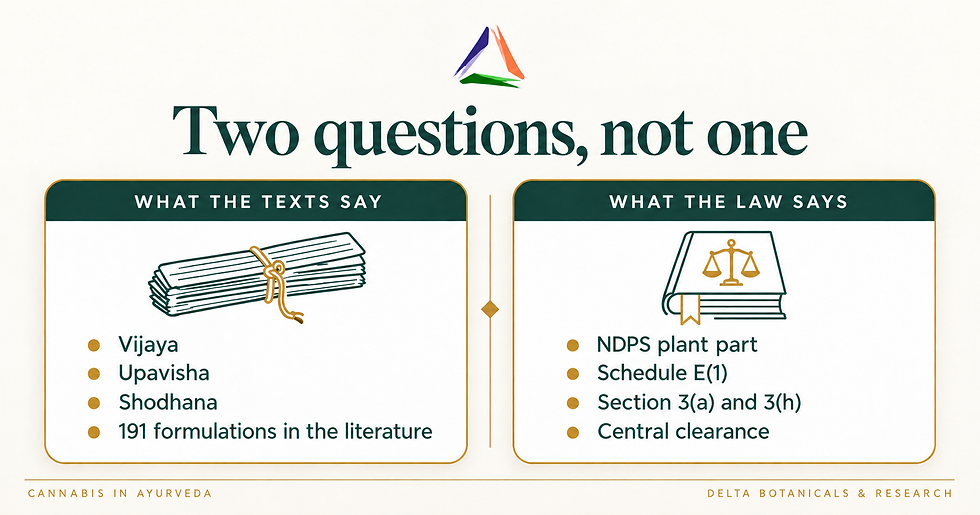
That matters because people searching for "cannabis in Ayurveda" are usually asking two different questions:What does the traditional literature actually say about cannabis?
and What does modern Indian law allow someone to do with it? The first is a question of history, materia medica and pharmacy. The second is a question of plant part, formulation, licensing, narcotics law, drug regulation and state jurisdiction. Much of today's conversation about "Ayurvedic cannabis" goes wrong by confusing the two. This article separates them.
If you are building a commercial product, our companion guide covers that pathway: How to Develop an Ayurvedic Cannabis Product in India.
What Is Vijaya in Ayurveda?

Cannabis sativa appears in Ayurvedic and later Indian medical literature under names including Vijaya and Bhanga. Modern discussion often treats Vijaya, bhang, ganja, hemp and CBD as though they were versions of one regulatory commodity. They are not.
Term | Historical or common context | Why the distinction matters today |
Vijaya | A name for cannabis in Ayurvedic literature | The name used in traditional materia medica and formulations |
Bhanga / Bhang | Associated in Ayurvedic and Indian usage with cannabis leaves and preparations made from them | "Bhanga (except seed)" is specifically listed in Schedule E(1) of the Drugs Rules |
Ganja | Traditionally the flowering material | Under the NDPS Act, ganja means the flowering or fruiting tops, excluding seeds and leaves when not accompanied by the tops |
Charas | Cannabis resin | Within the NDPS Act's definition of cannabis |
Hemp | Used commercially for low-THC or industrial contexts | There is no single national "hemp" category that overrides plant-part, product and state rules |
CBD | Cannabidiol, a constituent | A molecule or marketing label does not decide the legal classification of a finished product |
The NDPS definition is built into Section 2(iii)(b) of the Act. Leaves and seeds not accompanied by the tops fall outside the definition of ganja.
That does not make anything made from leaves unrestricted. States regulate bhang and related activity, and an Ayurvedic medicine adds a separate drug-regulatory layer. Plant part is where the analysis begins, not where it ends.
Cannabis in Indian Tradition: History, Religion and Ayurveda Are Not the Same Thing
India's relationship with cannabis is older and more complicated than today's CBD market. Bhanga is referred to in the Atharvaveda, among plants with ritual significance, although its precise botanical identification has been debated.
That is a caution against turning every ancient reference to bhanga into a modern pharmacological claim. Later religious and cultural traditions built a strong association between bhang and Shiva, still visible in festival practice.
Modern retellings often become too neat. A cultural story is not an Ayurvedic prescription. An Ayurvedic reference is not modern clinical evidence. A historical preparation is not permission to launch a contemporary product. Across periods, cannabis in India has been a ritual plant, an intoxicant, materia medica, an agricultural crop, a controlled substance and now a subject of pharmaceutical and regulatory research. Ayurveda is one part of that larger history.
What the Ayurvedic Literature Says About Vijaya

A 2026 review in Pharmacognosy Research, by researchers at the All India Institute of Ayurveda and collaborating institutions, summarises the classical picture:
Vijaya is described in the Nighantus (materia medica texts) under several synonyms, including Jaya and Samvidamanjari, a name referring to its clustered flowers.
It is placed in the Upavisha group, often translated as "minor" or "mild-potency" poisons.
The texts advise use only after shodhana, a prescribed purification or processing.
One of the fullest descriptions is in the Anandakanda, a Rasashastra text.
Ancient texts describe it as one of five sacred plants.
A 2015 review by Acharya and colleagues surveyed Ayurvedic texts and reported Vijaya as a single drug or ingredient in 191 formulations across 13 dosage forms. That figure shows a substantial documented presence. It does not mean that 191 cannabis products are authorised for manufacture today. Historical formulation evidence and modern licensing are different questions.
The literature also shows why "ancient wellness herb" distorts the record. Ayurveda did not treat Vijaya as a casual botanical. It placed rules around preparation, quantity and processing.
Why Shodhana Matters
Shodhana is often translated as purification or processing, though its meaning in Ayurvedic pharmacy is broader than cleaning away an impurity. Published research describes several processing methods for Bhanga, including water-based methods, and has examined how processing changes the physicochemical and cannabinoid profile of cannabis leaves.

The historical lesson is that traditional Ayurveda did not reason "cannabis is natural, therefore harmless". Its own pharmacy developed controls around the material, which fits the modern regulatory record. Under the Drugs Rules, Bhanga (Cannabis sativa Linn., except seed) is listed in Schedule E(1) among poisonous substances used in Ayurveda. The Ministry of Ayush has also stated in a public notice that ASU drugs containing Schedule E1 drugs are to be consumed under the supervision of a qualified practitioner.
The record is not that of an unrestricted lifestyle ingredient. It is that of a pharmacologically significant material expected to be handled with care.
How Many Classical Ayurvedic Cannabis Formulations Are There?
One frequently repeated figure is around 190 or 191. The most useful source is the 2015 review by Acharya and colleagues, which reported Vijaya as a single drug or ingredient in 191 formulations across 13 dosage forms in the texts it examined.
A separate 2016 review of Bhanga as a pharmaceutical processing medium reported it in 157 formulations across the classical and Rasashastra texts it covered.
The numbers differ because the researchers counted different things. One counts formulations in which Vijaya is an ingredient. The other examines its use as a processing medium, as in bhavana or swedana.
So avoid statements like "Ayurveda has exactly 191 cannabis medicines". The defensible version is: Cannabis has a significant and varied presence across the classical and pharmacopoeial literature, but the number depends on what is being counted.
What Makes Ayurvedic Medicine "Classical"?
A product is not a classical Ayurvedic medicine merely because it contains an ingredient mentioned in Ayurveda. Under Section 3(a) of the Drugs and Cosmetics Act, a classical ASU drug is made in accordance with formulae described in the authoritative books specified in the First Schedule.
That is quite different from putting Vijaya into a newly designed oil, gummy or capsule and calling it "classical Ayurveda". The formula matters. The source text matters. The method matters. Traditional provenance cannot be borrowed from one ingredient and transferred to an entirely new product.
Classical vs Patent or Proprietary Ayurvedic Medicine

Classical ASU medicine (section 3(a)) | Patent or proprietary ASU medicine (section 3(h)) | |
Foundation | A formula described in an authoritative text listed in the First Schedule | A formulation using ingredients drawn from the authoritative texts, but not itself a classical formula |
Formulation freedom | Limited by the classical formula | Greater scope for design, within the rules |
Differentiation | Mainly quality, manufacturing and brand | Greater potential for a distinctive formulation |
Regulatory question | Does the product faithfully follow the classical formula? | Does the formulation and its evidence satisfy the proprietary requirements? |
Rule 158B of the Drugs Rules sets out the proof of safety and effectiveness that applies to licensing these categories. For a company developing an Ayurvedic cannabis product, this is not academic. It affects formulation strategy, evidence, product naming, documentation and the licence application.
The decision itself belongs in our product development guide.
Is CBD Oil an Ayurvedic Medicine?
It would be too simple to say "CBD oil is not Ayurvedic". It would be equally misleading to say "cannabis appears in Ayurveda, therefore a CBD oil is an Ayurvedic medicine".
A product described commercially as CBD oil is not, by that description alone, an Ayurvedic medicine.
Its status depends on the source material, the extract, the complete formulation, the intended use, the claims, the manufacturing process and the regulatory route under which it is licensed.
Do not choose the regulatory category from the marketing name. Choose it from the actual product. A related point: a purified, standardised cannabinoid fraction developed as a drug is a different category again.
India's phytopharmaceutical drug class covers purified and standardised fractions with at least four defined bioactive or phytochemical compounds, approved as new drugs by CDSCO. It is distinct from the state-licensed ASU route, because ASU drugs can use crude extracts while phytopharmaceuticals are purified fractions.
Whether a cannabis-based product can follow that route also raises narcotics questions that need their own analysis.
Traditional Use Is Not the Same as a Modern Health Claim
Ayurvedic texts contain therapeutic descriptions in their own conceptual language. Modern brands operate under modern advertising and drug law, including the Drugs and Magic Remedies (Objectionable Advertisements) Act, 1954. A traditional indication does not automatically permit a company to repeat it in an advertisement, and a historical reference is not contemporary clinical proof. This article deliberately does not list traditional indications.
The 2026 review itself concludes that further research is needed to validate Ayurvedic formulations containing Vijaya. The evidence base is heterogeneous and should be assessed formulation by formulation, not generalised to "cannabis in Ayurveda" as a whole.
For a commercial brand the question is not "what did Ayurveda traditionally use cannabis for?" but "what can this specific licensed product lawfully and responsibly claim today?"
How Modern Indian Regulation Meets the Tradition
India is not choosing between ancient Ayurveda and modern cannabis law. Both operate at once.
Layer | What it means |
NDPS Act | Cannabis is defined through specific categories, including charas and the flowering or fruiting tops that constitute ganja. Seeds and leaves are excluded when not accompanied by the tops. |
State regulation | Material outside the central definition is not universally unregulated. States regulate bhang and related activity. In the 2026 study cited above, researchers obtained Vijaya leaves from a licensed vendor in Uttarakhand after approval from the State Excise Department. |
Drugs and Cosmetics Act and Rules | Ayurvedic drugs operate through the ASU framework, including the classical and patent or proprietary categories and Rule 158B. |
Schedule E(1) | Bhanga (except seed) is listed among the poisonous substances used in Ayurveda. |
Central review of Bhang-containing ASU drugs | See the timeline below. |
ASU rule amendments (2026) | The Drugs Rules were amended for the ASU sector in July 2026. |
So "Bhang is outside the NDPS definition of ganja, therefore an Ayurvedic cannabis product is legal" is incomplete, because it skips the drug-regulatory framework. And "cannabis is controlled under the NDPS Act, therefore Ayurveda cannot use cannabis" is incomplete too.
India's framework works through distinctions: plant part, source, formulation, product category, licence, state, claim and manufacturing pathway. The plant may be the same. The legal analysis is not.
Regulatory timeline
Date | Development | Why it matters |
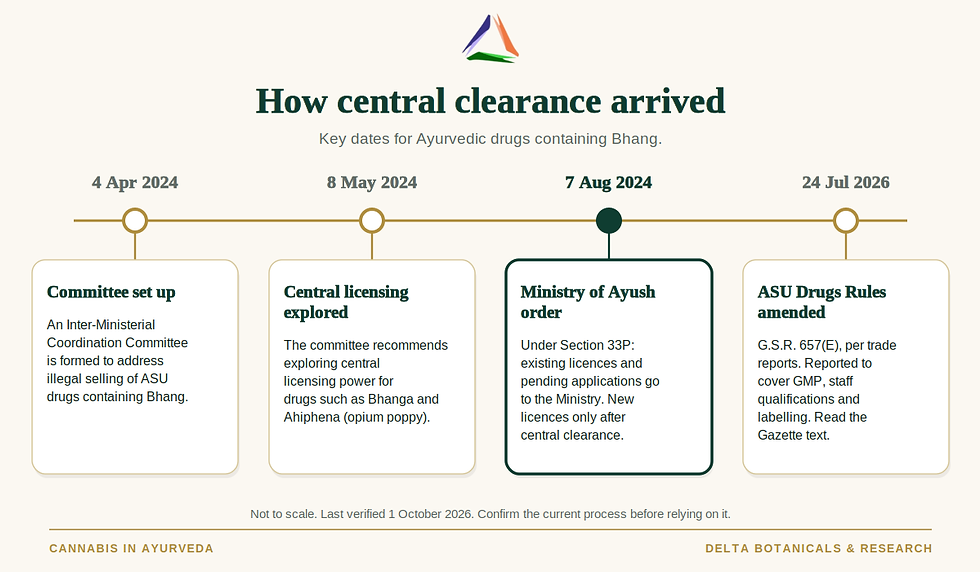
4 April 2024 | The Ministry of Ayush set up an Inter-Ministerial Coordination Committee to address illegal selling of ASU drugs containing Bhang | The context for what followed |
8 May 2024 | The committee recommended exploring central licensing power for drugs such as Bhanga and Ahiphena (opium poppy) | The reasoning behind the central step |
7 August 2024 | Ministry of Ayush order under Section 33P of the Drugs and Cosmetics Act. State and UT licensing authorities were directed to forward existing licences and pending applications under sections 3(a) and 3(h) for ASU drugs containing Bhanga, Ganja, Charas or Bhang (except seed), and Ahiphena (except seed). Such licences may be granted only after clearance from the Central Government. | An additional approval layer for these formulations |
24 July 2026 | The Drugs Rules were amended for the ASU sector (G.S.R. 657(E), per trade reports), with changes reported to cover areas including GMP standards, technical-staff qualifications and labelling or traceability | The ASU framework is evolving. Read the Gazette text for exact provisions |
Two cautions follow. We have not assumed that the 2024 clearance process works the same way today, so confirm how it operates before relying on it. And a rule about how an extract-based ASU formulation may be licensed would not by itself settle whether a particular cannabis extract can lawfully be sourced, manufactured, possessed or sold.
The narcotics question and the ASU-product question are connected but separate. That is why companies should not build a formulation first and ask about classification afterwards.
Common Misconceptions
"Cannabis is Ayurvedic, so cannabis products are legal." Historical use does not create a blanket exemption from narcotics, drug, manufacturing or state regulation.
"Bhang, ganja and charas are the same legal material." They describe different material, and the NDPS Act draws specific distinctions.
"If a classical text contains cannabis, anyone can make that formula." Commercial manufacture needs the applicable ASU licence.
"Adding Vijaya to an Ayurvedic formula makes it classical." Classical status depends on following a formula in an authoritative text.
"CBD content defines an Ayurvedic cannabis medicine." Cannabinoid analysis matters for chemistry, quality and compliance, but an ASU product's regulatory identity cannot be reduced to a CBD percentage.
"Ayurvedic tradition proves modern clinical efficacy." Traditional knowledge, pharmacological research and clinical evidence are different types of evidence.
Three Vocabularies, One Industry
India's cannabis industry sometimes tries to force very different vocabularies together. The international industry speaks of CBD, THC, full-spectrum, isolate and cannabinoid ratios.

Ayurveda speaks of dravya, formulation, samskara, shodhana, dosage form and textual authority. Indian regulation adds a third: NDPS definitions, Schedule E(1), section 3(a), section 3(h), Rule 158B, licensing authorities and product-specific compliance.
A serious Ayurvedic cannabis business has to understand all three. Translating Vijaya as "CBD" loses the traditional formulation. Calling a modern cannabinoid extract "ancient Ayurveda" loses historical accuracy.
Ignoring cannabinoid chemistry because a formulation is traditional ignores modern quality control. The opportunity lies in connecting these systems without pretending they are identical.
If You Are Evaluating an Ayurvedic Cannabis Product
Understanding the tradition is the first layer. A commercial product needs a different exercise: deciding what you intend to manufacture, whether the formulation is classical or proprietary, what cannabis material or extract you will use and where it comes from, how the manufacturer is licensed, what review applies, what specifications are required and what the label may say.
Our companion guide covers that pathway: How to Develop an Ayurvedic Cannabis Product in India: Formulation, Licensing, Manufacturing and Launch.
For companies evaluating Ayurveda-based cannabis formulations, Delta Botanicals & Research supports regulatory pathway assessment, formulation strategy, sourcing and manufacturing coordination.
Frequently Asked Questions
What is Vijaya in Ayurveda?
Vijaya is a name for Cannabis sativa in Ayurvedic literature. Later sources place it in the Upavisha group and describe processing (shodhana) before use. The Drugs Rules separately list Bhanga except seed in Schedule E(1).
Is cannabis part of Ayurveda?
Yes. Cannabis has a documented presence in Ayurvedic literature and pharmacy. A 2015 review counted it in 191 formulations across 13 dosage forms. That historical presence does not determine the regulatory status of any particular modern product.
What are classical cannabis formulations in Ayurveda?
They are formulations whose formula and method come from authoritative texts recognised under the Drugs and Cosmetics framework. A formulation is not classical merely because it contains Vijaya.
What are ASU cannabis products?
ASU cannabis products are Ayurveda, Siddha or Unani drugs that contain cannabis (Bhanga/Vijaya) as an ingredient. They are licensed as drugs by state licensing authorities, and since the Ministry of Ayush's order of 7 August 2024, formulations containing Bhang need central clearance.
What is shodhana of Bhanga?
Shodhana is the Ayurvedic processing applied to certain substances before use. Published research describes several methods for Bhanga, including water-based processing. It is part of Ayurvedic pharmacy and is not proof that processed cannabis is universally safe.
Is Ayurvedic cannabis legal in India?
There is no one-word answer for every product. ASU medicines containing Bhang can operate within India's Ayurvedic drug framework, but plant part, formulation, sourcing, licence, state regulation and the central clearance requirement all matter.
What is the difference between bhang, ganja and charas?
They are not legally interchangeable. Under the NDPS Act, ganja is the flowering or fruiting tops of the cannabis plant, excluding seeds and leaves when not accompanied by the tops. Charas is separated resin. Bhang is generally associated with leaves or leaf preparations and is regulated through state and drug-regulatory controls.
Does Ayurveda use CBD?
Classical texts describe plants, preparations and formulations, not isolated cannabinoids such as CBD. Modern testing can measure cannabinoids in materials and formulations, but calling a product "CBD" does not make it Ayurvedic.
What is the difference between classical and proprietary Ayurvedic medicines?
A classical ASU medicine follows a formula in an authoritative text. A patent or proprietary ASU medicine uses ingredients from the recognised texts without being the classical formula.
What is the difference between an Ayurvedic cannabis product and a phytopharmaceutical drug?
An Ayurvedic product is an ASU drug licensed by a state licensing authority. A phytopharmaceutical drug is a purified and standardised fraction with at least four defined compounds, approved as a new drug by CDSCO.
How are Ayurvedic cannabis products made?
Through a licensed manufacturer whose licence covers the specific product: a defined classical or proprietary formulation, lawfully sourced and processed material, quality specifications and the applicable licences and clearances. See our development guide.
Can a company launch an Ayurvedic cannabis product in India?
Potentially, but only after the product is classified correctly and the applicable licences and clearances are in place. The route depends on the formulation, source material and intended claims.
Related Reading
Sources and References
Ministry of Ayush, Order T-11011/11/2021-DCC dated 7 August 2024 (ASU drugs containing Bhang), issued under Section 33P of the Drugs and Cosmetics Act, 1940: https://tnslaim.tn.gov.in/pdf/ayush-files/ORDER_Illegal_Selling_of_Ayurveda_Siddha_and_Unani_2.pdf
Shalini V. et al., "Decoding Vijaya (Cannabis sativa L.) Leaves," Pharmacognosy Research 2026; 18(1):153-162, DOI 10.5530/pres.20262239: https://www.phcogres.com/article/18/1/153.pdf
Acharya R. et al., "Vijaya (Cannabis sativa Linn.) and its therapeutic importance in Ayurveda: a review," Journal of Drug Research in Ayurvedic Sciences, 2015 (191 formulations, 13 dosage forms).
Tavhare S. and Acharya R., review of Bhanga as a processing medium in Ayurvedic classics and Rasashastra, 2016 (157 formulations).
Drugs and Cosmetics Act, 1940, Section 3(a) and 3(h); Drugs Rules, 1945, Schedule E(1) and Rule 158B.
Narcotic Drugs and Psychotropic Substances Act, 1985, Section 2(iii).
Ministry of Ayush public notice on ASU drugs containing Schedule E1 substances: https://nih.ayush.gov.in/assets/uploads/notice_pdf/content_matter_en_1745221919.pdf
CDSCO, FAQs on approval of new phytopharmaceutical drugs: https://www.cdsco.gov.in/opencms/export/sites/CDSCO_WEB/Pdf-documents/New-Drugs/FAQs/New_Drugs_FAQs.doc
Trade report on July 2026 amendments to the Drugs Rules, 1945 (ASU): https://drugscontrol.org/news-detail.php?newsid=45500 (obtain the Gazette of India notification, G.S.R. 657(E), for the primary text).


Comments